
Putin has problems, so expect volatility

After four years of intense fighting, the Ukraine War appears to be no closer to resolution. Russian offensive operations are currently stalled and Ukraine has reversed recent trends capturing more ground than its opponent this April and May.
The Russian economy is starting to show signs of strain and is close to its productive capacity.[i] Russia’s central bank recently sold 27.9 tonnes of its gold reserves, worth more than US $4 billion[ii]. Interest rates are high, labour is scarce and any expansion of defence production will require mobilisation for war. A situation Putin has steadfastly avoided to date.
Meanwhile, Ukraine’s air campaign continues to impact on Russia’s primary source of external revenue – the oil industry. For example, Russian diesel production fell by 10% in May 2026[iii] and oil exports are banned until 31 July 2026.[iv] Putin making sure domestic fuel requirements are met. Although, the US war with Iran has resulted in sanctions on Russian oil reduced as several nations waive sanctions to secure supply.[v] However, Ukraine’s air campaign remains a physical sanction by damaging the infrastructure Russia needs to export its oil.
Essentially, Ukraine has ‘brought the war home’ to ordinary Russians who see fuel prices rising, shortages of consumer goods and drone attacks far from the frontline that raise questions about security. Since last month, access to the internet, mobile network[vi] and to Telegram and Whats App have been curtailed for ‘security reasons’.[vii] Restrictions that impact on ordinary Russians and raise further questions about security and stability.
Historically, in Putin’s Russia ordinary people have sacrificed freedom and turned a blind eye to endemic corruption in exchange for stability, security and prosperity. If Putin cannot demonstrate strength and competence, he loses confidence and political capital.
Already, there are subtle hints of insecurity with more reports of political tension and protests. Putin’s personal security measures are increasing and he is appearing less often in public.[viii] Also there are reports of minor conflicts between military and security agencies that may indicate underlying tensions.[ix]
Although he is facing a range of domestic challenges, Putin’s biggest strategic problem is that European nations continue to fund Ukraine. Europe’s support has increased as US aid has reduced, so Ukraine’s defence can be sustained.
A combination of domestic and strategic factors that put Putin ‘on the back foot’ and in an insecure position. If he cannot demonstrate success soon, he is liable to lose domestic support among the elites that keep him in power. Therefore, Putin needs to reassess his strategy and take action to stabilise the situation.
Considering the current situation
Russia is defeated at sea, the Black Sea Fleet either sunk or in hiding. On land the conflict revolves around capturing ground, Russia pushing to conquer territory and Ukraine defending or counter-attacking.
The war will be won on land, but Russia is stuck, its military leadership is not adept enough, its equipment is outdated and its soldiers are poorly trained. So, even after throwing millions of soldiers at Ukraine’s defences and suffering approx. 1.2 million casualties Russia is not making progress. In fact, during April Ukraine ‘turned the tables’ on Russia inflicting a net loss of 116 square kilometres (45 square miles) on Russia’s forces.[x]
In May, the US Defence Intelligence Agency reported that this quarter Ukraine has re-captured 400 square kilometres (154 square miles).[xi] A feature of recent Ukrainian success is the increasing sophistication of its drone use. Ukraine successfully integrating air and ground drones into combined arms tactics.[xii]
While Ukraine innovates and improves, Russia performs poorly against both key metrics of the land campaign. Losing more ground than it captures and suffering enormous casualties. Some commentators report that Russian casualties are now higher than its rate of recruitment.[xiii] A situation that if true bodes very poorly for Russia’s ability to sustain the war.
It is clear that Putin’s current plan is not working and that he needs to take action to reset the campaign. But what can he do?
Putin’s options – What could he do, to get the reset he needs?
It is unlikely, that Putin will seek a ceasefire anytime soon. This option is philosophically unpalatable, and politically unsustainable because a ceasefire without complete control of the four oblasts annexed in 2022 would be interpreted as a defeat.
An assessment backed up by Estonia’s International Centre for Defence and Security that recently reviewed annual intelligence summaries from Baltic and Scandinavian nations, and concluded that “Perhaps the most consistent conclusion across the Nordic and Baltic assessments is that Russia has entered a period of sustained confrontation with the west. The services describe a Russian state that has adapted its political, military, and economic systems to support prolonged conflict.”[xiv] Good evidence that Russia and its leader are locked in a campaign with the ‘West’ that they see as existential.
If ceasefire is out of consideration, then we are a left with the following potential options:
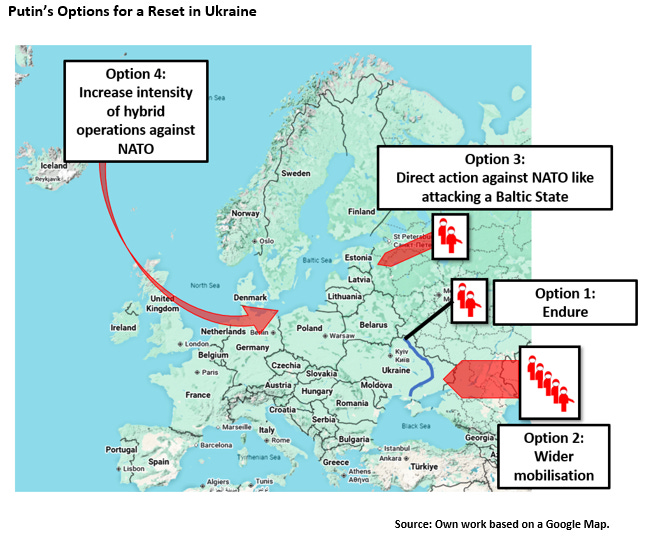
Option 1: Endure. Russia maintains pressure on Ukraine in the land campaign, continuing to recruit contract soldiers as required. But its aim is now to consolidate and hold the current frontline, rather than advance. The long-term objective is to wait out European support and minimise resources committed to the war. The end state is a frozen conflict that inflicts a long strategic campaign of economic warfare on Ukraine, that constantly needs to fund its defence and work to maintain European support. Ukraine’s political and business leaders knowing that any military defeat or loss of European support will be quickly taken advantage of by Russia.
Option 2: Wider Mobilisation. Putin ‘bites the bullet’ and fully mobilises Russian society and the military. This option would raise approx. 500,000 more soldiers that could be deployed into Ukraine. A realistic objective is to secure the four annexed oblasts, and the Donetsk Fortress Belt. If this objective is achieved it would be a victory for Putin allowing him to progress into realistic ceasefire negotiations.
Option 3: Direct action against NATO like attacking a Baltic state. Russia launches a direct attack against a NATO state, probably one of the small Baltic republics. The strategic objective is to scare European nations and split the alliance, Russia escalating to try and scare NATO In de-escalating. An attack that may test the NATO treaty because although most members would be prepared to defend NATO there is a chance that some may step back from the conflict, especially if the US showed a lack of commitment to the alliance. Any split in the alliance enables Putin push harder.
Option 4: Increase intensity of hybrid operations against NATO. Russia is already engaged in a range of hybrid operations against European countries. Increasing the intensity is a relatively inexpensive form of economic warfare against the NATO alliance. Like a direct attack, this campaign forces members to increase defence and security spending. A challenge that Russia could use to increase divisions in the alliance. Putin playing off the potential for countries that are not directly threatened or impacted by hybrid operations, to object to increases in spending and withdraw support.
But what is the most likely option?
My assessment is that Putin’s most likely option is a combination of Options 1 and 4. In Ukraine Russia can maintain pressure by continuing to recruit contract soldiers from around the world. Putin accepts limited operational-level progress in exchange for knowing that Ukraine is being economically depleted. This option creates a strategic pause that weakens Ukraine by draining its economic resources and provides time for its supporters to lose interest.
Meanwhile, more hybrid operations are conducted in the North Sea, Baltic and in NATO countries that vocally support Ukraine. This increases the cost of security and therefore the likelihood that NATO members that are either; not directly threatened with attack, or are being targeted by hybrid operations may seek to disengage and withdraw support from Ukraine.
This option is the safest because although Russia’s economy and Putin are under pressure, a coup it still remains unlikely based on the information at hand. Therefore, Putin probably has time to take a cautious approach to resetting the situation rather than taking a political risk by introducing full mobilisation, or a military risk by directly attacking NATO.
What is the most dangerous option for Ukraine?
The most dangerous option for Ukraine is Option 2, wider mobilisation. Ukraine is currently managing to hold Russia’s advances and may even be starting to develop a tactical advantage that could lead to successful future offensive operations. However, the sudden deployment of another 500,000 soldiers will tip that balance, maybe even enough to defeat Ukraine.
However, this option is unlikely because history tells us that Putin is keen to avoid full mobilisation. This reticence indicates that full mobilisation has a very high political risk. So, this option is less likely than the proposed combination of Options 1 and 4.
What is the most dangerous option for Putin?
Option 3, a direct attack on NATO, is certainly the riskiest option for Putin. The alliance may have its weak links but over the last four years it has become increasingly focussed on deterring Russia and supporting Ukraine. So, my assessment is that an attack on Latvia, Lithuania or Estonia would be met with very strong resistance and would unite NATO members rather than scare them into de-escalating. Russia is already struggling to defeat Ukraine and Putin probably understands that a war with even just the Nordic NATO members, and their committed partners (the UK, Canada and France) would invite defeat.
Conclusion
The Ukraine War is at an important stage as pressure mounts on Putin. He certainly faces economic issues, is probably under political scrutiny and is not making progress militarily so needs to take action to reset his war. A range of options exist and over the next few weeks and months his thinking will become apparent.
It is a time to carefully watch what a cornered man is capable of doing, will Russia escalate? Or will Putin try to endure the current situation, betting on Ukraine or Europe weakening?
We do not know but we should be prepared for volatility.
Thanks for reading my work. If you like this content and want to support it you can ‘Buy me a Coffee’ here - buymeacoffee.com/benmorgan
[i] https://fortune.com/2026/05/24/russian-economy-gdp-contraction-inflation-oil-prices-ukraine-war-elites- financial-crisis/ and https://www.iiss.org/research-paper/2026/05/the-coming-crisis-in-russias-political-economy/
[ii] https://www.aljazeera.com/news/2026/5/29/russian-rate-of-losses-in-ukraine-almost-triples-in-one-year
[iii] https://www.reuters.com/business/energy/russias-diesel-output-falls-further-10-may-after-drone-attacks-data-analysis-2026-05-29/
[iv] https://www.reuters.com/business/energy/oil-refining-standstill-central-russia-after-ukrainian-drone-strikes-sources-say-2026-05-20/
[v] https://www.intellinews.com/eu-mulls-freezing-russian-oil-sanctions-as-fuel-shortage-looms-445736/ and https://www.bbc.com/news/articles/cy42x3g7r89o and https://www.aljazeera.com/news/2026/5/19/us-extends-sanctions-waiver-on-russian-oil-why-it-matters
[vi] https://www.nbcnews.com/world/russia/russia-moscow-internet-outages-putin-ukraine-drones-crackdown-fears-rcna263634
[vii] https://www.nbcnews.com/world/russia/russia-killing-telegram-popular-messaging-app-fears-pushback-rcna263904 and https://www.bbc.com/news/articles/clygd10pg5lo
[viii] https://www.dw.com/en/how-real-is-a-coup-threat-against-russias-president/a-77098085
[ix] https://edition.cnn.com/2026/05/04/europe/putin-russia-security-intelligence-intl and https://www.kyivpost.com/post/75390
[x] https://edition.cnn.com/2026/05/14/europe/russia-winning-streak-ukraine-over-intl-cmd
[xi] https://www.aljazeera.com/news/2026/5/29/russian-rate-of-losses-in-ukraine-almost-triples-in-one-year
[xii] https://benmorganmil.substack.com/p/a-tactical-revolution-in-ukraine and https://benmorganmil.substack.com/p/russia-needs-a-victory-this-spring and https://benmorganmil.substack.com/p/are-we-observing-a-tactical-revolution
[xiii] https://www.aljazeera.com/news/2026/5/29/russian-rate-of-losses-in-ukraine-almost-triples-in-one-year and https://www.kyivpost.com/post/75456
[xiv] https://icds.ee/en/signals-from-the-north-what-nordic-and-baltic-intelligence-assessments-reveal-about-russia/
Thanks for reading my work. If you like this content and want to support it you can ‘Buy me a Coffee’ here - buymeacoffee.com/benmorgan
One of the more disciplined option breakdowns I've read on this — keeping "most likely" and "most dangerous" as separate questions is what most of these analyses collapse together. One thing worth adding on the manpower side: the economic squeeze you describe may cut the other way for recruitment. A deepening downturn lowers the price of a soldier. As regional unemployment climbs past what Rosstat reports and real incomes fall across much of the country, the contract stops being a bonus-driven choice and becomes the only viable income for a lot of men. So Russia may not need to keep raising payments — a worse economy does some of the recruiting for it.
Thanks again for another insightful article, Ben. I concur with your assessment that "Option 1: Endure." is most likely. If Putin can get away with it an Russia continues it's supine endurance, I fear that Europe's populations will lose interest. But surely even most European public realise that Trump's USA is no longer reliable, and that Ukraine is Europe's FRONT LINE against Russia?