

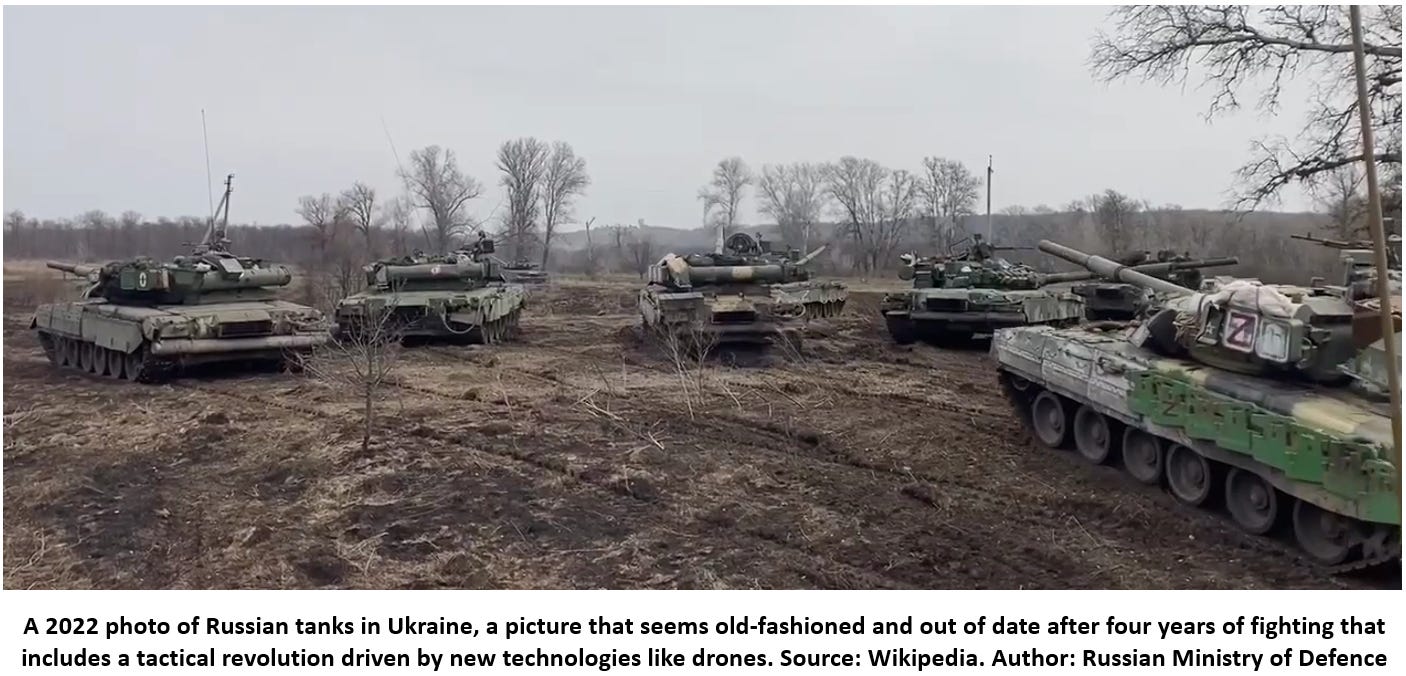
Russia is losing the Ukraine War and a reason why is its failure to respond effectively to Ukrainian strategy. In simple terms, Russia has lost the initiative and acts in accordance with Ukraine’s script rather than shaping the campaign. While this situation continues Russia will become weaker and weaker, until it eventually fails. The failure may take time but without a significant change in Russian strategic thinking it becomes increasingly likely, or perhaps inevitable.
This situation also provides excellent insight into a failure of strategy and leadership that is a lesson for all nations. For instance, Russia’s situation is worryingly similar to the US position in Iran. Both are poorly planned expeditions, hastily organised based on bad intelligence that have ensnared a major military power in a longer than expected conflict. Notably, both Iran and Ukraine have grasped fundamental changes in tactics that their larger opponents do not appear to have considered deeply enough before committing military resources.
Ukraine’s strategy - simple and effective
Ukraine’s strategy is simple, on the ground Ukraine is heavily out-numbered so instead of attacking it fights a defensive campaign designed to attrit Russian forces. Ukraine trades ground for time and inflicts the highest possible casualties on Russia by forcing its enemy to attack. It has used the time Russia invested in capturing towns like Avdiivka, Bakhmut, and Pokrovsk to develop new drone technologies, tactics to use these weapons effectively, and the nation’s defence industry to build enormous numbers of drones.
Concurrently, Ukraine started a strategic air campaign against Russia - using long-range drones and missiles aiming to damage Russia’s economy and create political instability. The logic is simple; without foreign revenue Russia is forced to use cash and gold reserves to buy equipment or pay for contract soldiers. Meanwhile, on the battlefield Ukraine’s defensive tactics attrit Russian resources increasing the cost of the war and accelerating Russia’s financial losses. And, eventually the money will run out forcing the Kremlin to negotiate or take political risks by introducing economic policies that impact ordinary Russians. For example, introducing petrol rationing or ordering a full mobilisation.
Initially, the air campaign attacked Russian oil and gas infrastructure - specifically refineries. The Centre for European Policy Analysis’s Sergiy Makogon recently wrote “Ukraine has turned refinery strikes into a systematic campaign against the core of Russia’s oil-processing network. Meduza reported that by the end of May, citing Reuters, every large refinery by processing volume in the European part of Russia has now been attacked at least once by Ukrainian drones.”[i] A campaign that’s impact is verified by independent reporting that confirms the widespread disruption of Russian domestic fuel supplies.
However In recent weeks, the air campaign has extended to include Russia’s largest online shopping chain - Wildberries. The company’s logistics infrastructure is slowly being bombed out of existence. PBS reports that “Mykhailo Podolyak, an adviser to Ukrainian President Volodymyr Zelenskyy, said the attacks were designed to disrupt military supplies, breed popular discontent and cause a domino effect in the Russian economy by putting stress on major banks, including VTB and Sberbank, that made massive loans to Wildberries.”[ii]
Wildberries is one of Russia’s largest businesses worth between US $ 81-87 billion, a figure that various estimates put at approx. 2-3% of Russia’s GDP. [iii] The chain also employs large numbers of Russian workers and provides a logistics network for many small and medium-sized Russian businesses. Wildberries and its competitor Ozon are estimated to account for economic activity worth around 8.5% of Russia’s GDP and support approx. 4 million jobs, around 5% of Russia’s workforce. [iv]
Finally, the chain relies on loans from Russia’s biggest banks and a default on payments could have larger financial impacts.
Notably, the Russian banking system is also under threat because customers are withdrawing cash worried that the Kremlin will seize their deposits to fund the war. Since the beginning of the year Russians have withdrawn approx. US $ 28 billion from banks[v] but in recent months the rate of withdrawals has increased; reportedly US $ 4.3 billion in June, US $ 7.2 billion in July, followed by US $ 3.4 billion in the first two weeks of August.[vi]
The Russian economy is under pressure and Ukraine does not need to destroy it to win. It just needs to make Putin’s political position untenable and there is evidence that the campaign may be having an impact. Putin ally and Moscow Mayor, Sergey Sobyani recently warned about the impact of full economic mobilisation.[vii] Andrei Klepach, chief economist at state bank VEB was recently fired because of a speech in May to an economic forum. In his speech, Klepach said that Russia “We will not win the competition in this war of attrition” and that Ukraine “… has not collapsed and will not collapse.”[viii] When powerful people like these speak out, and ordinary Russians cannot use Wildberries, or buy petrol it indicates that trust and confidence in Putin’s regime is being undermined.
Ukraine is also winning at the operational and tactical-levels of war
After Elon Musk shut down Russian access to Starlink in February 2026 the Ukrainians immediately attacked Russian forces along the southern frontline. On 12 August, Ukraine commented on the result of their summer ground operation that has been dubbed the Oleksandrivka Counteroffensive. Ukraine claims to have recaptured 745 km² and 26 villages in the Dnipropetrovsk, Donetsk, and Zaporizhzhia oblasts.[ix]
This is a significant amount of territory but my assessment of Ukraine’s objective is that this operation’s goal is to distract Russia from its main effort – capturing the remainder of Donetsk Oblast rather than to capture ground. Although the territorial gains are important Ukraine’s offensive contributes to a more important goal; preventing Russia achieving its objectives in Donetsk.
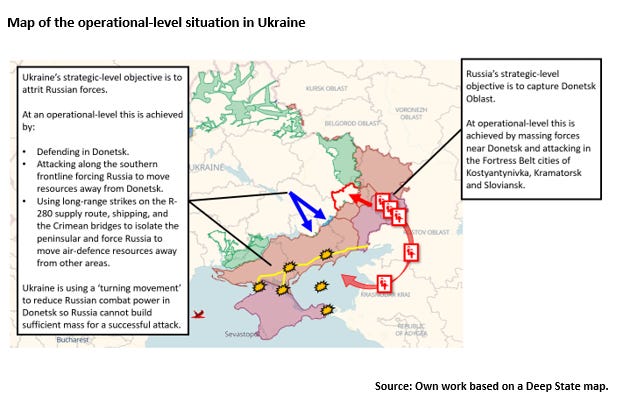
The military reality is that capturing Donetsk requires Russia to build up enough combat power to overwhelm Ukraine’s defences. Ukraine’s successful offensive along the southern frontline forces Russia to displace combat power to the south-west so these resources cannot be used in Donetsk. Ukraine is using its small attacks to weaken Russia’s Donetsk offensive in the same way the Kursk Offensive diverted Russian resources away from Pokrovsk in 2024.
The situation is compounded by two other factors. The first is Ukraine’s ‘deep battle,’ or its drone and missile strike campaign against Russia’s supply lines and the bridges into Crimea. Ukraine’s attacks on Russia’s depth disrupt the flow of supplies to frontline troops and to the garrison of Crimea. The strikes also force Russia to spread its air-defence assets wider, reducing their coverage and creating weak spots that can be attacked by Ukraine.
The second factor is Ukraine’s tactical evolution. Since 2024, Ukraine’s drone programme has developed exponentially and new combined arms tactics that integrate drones are evolving. For example, this week the Institute for the Study of War reported that “A Kremlin-affiliated Russian milblogger claimed on March 12 that Ukrainian forces in the Oleksandrivka direction were advancing both with dismounted infantry and with armored fighting vehicles. These reports suggest that Ukrainian forces managed to employ elements of mechanized maneuver at the tactical level to retake several settlements.”[x] Since early this year evidence of Ukraine’s integration of drones into combined arms tactics has started to appear in the public realm [xi] and the success of these operations is potentially another indicator of this trend.
If Ukraine’s plan is so simple – Why can’t Russia stop it?
Unfortunately for Russian generals, political interference means their assaults on targets in Donetsk must continue, regardless of the wider operational of tactical-level situation. Therefore, Russian commanders maintain a tempo of smaller than ideal assaults that can be defeated in detail by the defenders. And, each defeated attack in Donetsk carries a ‘bill’ that must be paid in soldier’s lives, lost equipment and supplies.
Any vaguely competent military leader should understand Ukraine’s strategy, its execution, and how to respond and we should not under estimate Russia’s generals. However, since the siege of Pokrovsk started Russia’s operational-level campaign has focussed on capturing Donetsk Oblast. A rigid pattern of behaviour that probably indicates political direction from Putin, and that Russia’s strategic goal is to capture this oblast. Probably to secure (most of) the territory annexed by Russia so that Putin can finish the war with ‘victory’ declared.
This creates an uneasy tension for Russian commanders because their nation’s economy and people are not going to support the war forever and the police and Rosgvardia cannot suppress discontent indefinitely. Therefore, the need to act quickly means that it is likely political pressure and interference in military planning will increase making it ever harder for Russia’s generals to say ‘No’ and reset the campaign. Russia risks falling into a self-perpetuating cycle of defeat as political interference degrades military performance that in turn, encourages politicians to intervene more.
Ukraine is taking advantage of this dynamic. A basic rule of war is that it costs more lives, equipment, and resources to attack than it does to defend. This rule’s impact is compounded if the attacker is predictable and continues to attack on the same axis. While Russia’s military leaders are constrained by political inflexibility and forced to try and take Donetsk they are doomed to fail, throwing away lives and resources trying to breech Ukraine’s ‘Drone Wall.’
We can speculate that a similar dynamic may also be impacting on the US military as it struggles to achieve the poorly thought out (and rapidly changing) objectives of its political leaders regarding Iran. The US’s initial objective, regime change, was poorly conceived and highly unlikely to be achieved without the deployment of ground forces. History tells us that bombs alone do not change regimes.
Like Ukraine, Iran responded with asymmetric means using cheap, plentiful, and hard to counter drones and missiles to choke the Straits of Hormuz. Now US generals face a conundrum trying to craft a campaign constrained by contradictory political direction.
Conclusion
Since 2022, it has become increasingly clear that the Russian Bear’s ‘eyes were too big for its stomach’ and that Ukraine has proven impossible to swallow. Russia stumbled into this war with a vague idea that a sudden attack would create a shock that would force regime change.
Russia’s intelligence proved to be flawed and it is now mired in a war that it will probably lose. Initially, Putin and his generals tried to bluff their way out of the situation believing that Ukraine’s supporters across the world’s liberal democracies would give up – afraid of Russia. When that tactic failed it became necessary to limit their military objectives to only what they need to claim victory, Donetsk.
It is a campaign notable for its lack of planning and integration between the vision of Russia’s political leaders and the practical realities experienced by its military. Ukraine’s campaign planning ‘on the other hand’ is sharpened by fighting an existential war against a powerful and ruthless opponent. Therefore, Ukraine is able to deliver a focussed long-term strategy that integrates all operations from strategic to tactical-level.
The Ukraine War demonstrates that the success of any military of geo-political strategy is based on achieving a balance between political vision and military pragmatism. A powerful lesson for leaders on both sides of the civil – military partnership, especially in our increasingly unstable world.
Thanks for reading my work. If you like this content and want to support it you can ‘Buy me a Coffee’ here - buymeacoffee.com/benmorgan
[i] https://cepa.org/article/ukraine-strikes-russias-central-nervous-system/
[ii] https://www.pbs.org/newshour/world/ukraine-takes-aim-at-russias-economy-and-morale-by-attacking-online-retailer-wildberries
[iii] https://www.euronews.com/my-europe/2026/08/17/ukraine-has-hit-seven-of-russian-online-retailer-wildberries-10-biggest-warehouses-militar and https://www.aljazeera.com/news/2026/8/12/ukraines-strikes-on-russias-wildberries-arent-about-the-front-line
[iv] Ibid.
[v] https://www.euronews.com/2026/08/19/russians-pull-billions-from-banks-fearing-kremlin-will-seize-savings-for-war NB.I converted Euros used in the article into US dollars.
[vi] https://www.independent.co.uk/news/world/europe/russia-banks-withdraw-money-putin-war-b3035506.html NB.I converted US dollars used in the article into US dollars.
[vii] https://www.kyivpost.com/post/81870
[viii] https://www.reuters.com/business/finance/russian-state-bank-fires-economist-who-warned-moscow-was-losing-war-attrition-2026-08-17/
[ix] https://euromaidanpress.com/2026/08/14/745-km%C2%B2-recaptured-in-ukraines-eight-month-oleksandrivka-counteroffensive-kyiv-says/
[x] https://understandingwar.org/research/russia-ukraine/russian-offensive-campaign-assessment-august-15-2026/
[xi] https://benmorganmil.substack.com/p/a-tactical-revolution-in-ukraine
Ben, a strong analysis. I would sharpen one distinction, though: forcing an opponent to react is not necessarily the same as possessing the strategic initiative, just as imposing economic and operational costs is not yet the same as converting those costs into strategic effect.
The real measure is conversion. Do Ukraine’s deep strikes, attritional defence and tactical counteroffensives alter Russia’s capacity or political willingness sufficiently to prevent Moscow from achieving the objective it still considers essential? Until that conversion occurs, tactical adaptation and operational disruption should not automatically be read as strategic defeat.
I would also distinguish political direction from political interference. Politics must determine the purpose of war; that is not interference. The failure begins when political leadership dictates military method, suppresses operational feedback, or refuses to revise an objective after the relationship between ends, means, cost and time has fundamentally changed.
Seen this way, Russia’s deeper vulnerability may not simply be that politicians constrain generals. It may be that its decision architecture cannot efficiently reconcile political purpose with changing operational reality. That is a more dangerous failure, because it can preserve tactical activity long after strategic coherence has begun to erode.
Great analysis, is an interesting subject many conclusions can be produced, but yours can be very strong in my opinion