
Wheeled armour - Too big to fight?
Guest contributor and ex-armoured corps officer, Graeme Doull discusses the trend towards larger wheeled armoured fighting vehicles being used to equip motorised forces.

Motorised forces fill a gap between light infantry units and heavier- armoured or mechanised formations. Historically, motorised formations use wheeled vehicles and prioritise operational mobility over protection. However, the pursuit of greater protection has pushed modern wheeled armoured vehicles to become bigger and more cumbersome. The financial impact is clear but the operational cost - paid for in lost tactical utility, increased logistics requirements, and diminished flexibility - is not as transparent.
When it entered service the US HMMWV or Humvee - was criticised for being too wide to navigate narrow village roads or turn in tight urban spaces. Its size was seen as a tactical problem - forcing commanders to use specific, limited, and predictable avenues of approach. Today, the Humvee is dwarfed by the massive wheeled platforms various militaries are starting to field.
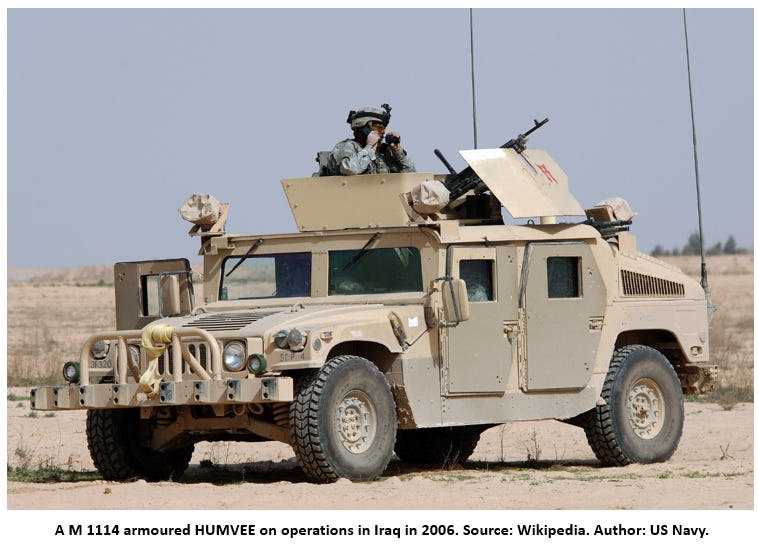
Recent Australian Defence Force (ADF) procurements provide a case study, and comparing Australia’s most recent purchases against the Humvee we can see a striking expansion in vehicle size:
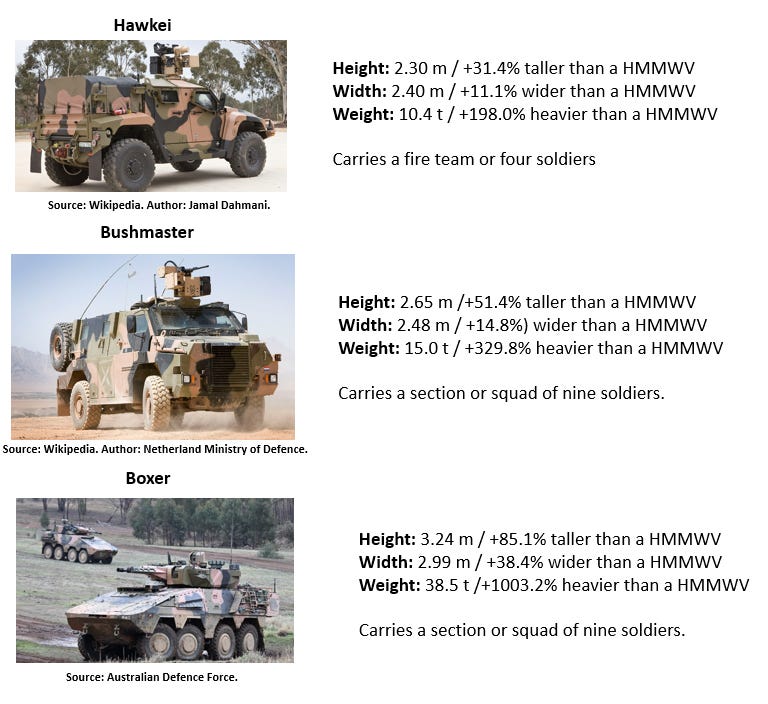
The weight comparisons are based on the Gross Vehicle Mass (GVM) or maximum combat weight for each platform, compared against the standard 3.49-ton GVM of the baseline unarmoured M998 HMMWV.
Role of Mechanised vs Motorised Forces
While there is a case for mechanised forces - working with main battle tanks - to be better protected, motorised vehicles have a different role to play and the focus on protection seems to have created vehicles at odds with their intended purpose.
Mechanised forces are built for high intensity, combined arms combat alongside main battle tanks. Their primary role is to breach fortified defensive lines, repel heavy attacks and conduct deep offensive manoeuvres. Troops fight in close coordination with their vehicles to project continuous combat power.
Motorised forces focus on rapid strategic movement and then holding key terrain in complex environments. They use speed to rush into defensive positions or urban settings, where they dismount to fight. Fast wheeled vehicles also allow them to act as flank or rear area security and to rapidly withdraw and redeploy but their lower level of protection dictates they operate away from direct, high intensity operations.
Navigating the Modern Battlespace
Large vehicles may be able to navigate the wide-open spaces of the Australian Outback, the rolling plains of Europe, or barren deserts expanses in the Middle East. But modern combat is increasingly urbanised and, particularly in the Indo-Pacific, defined by complex, restrictive terrain.
A Hawkei, Bushmaster or Boxer - may be able to fit down broad main roads or open terrain - but will be difficult to manoeuvre in the built-up areas and dense jungle where future regional conflicts are likely to unfold.
Viewed through a Pacific lens - Australia’s forward-defence environment - the argument for downsizing becomes compelling. Local infrastructure, light bridges, and tight, narrow jungle tracks simply cannot support 30- to 40-tonne vehicles. Even their smallest armoured vehicle - the Hawkei at over 10 tons and 2.4m wide - is too heavy and too broad to be widely deployable in Melanesia or South East Asia.
The Survivability Paradox: Fighting the Last War
The push for massive vehicles was largely driven by the need to survive IEDs - a crucial capability during the Global War on Terror (GWOT) and this trend is global.
However, we must ask if armies are making the predictable error of fighting the last war by procuring these large vehicles?
In a future war against an adversary with large quantities of modern advanced anti-armour weapons and massed, cheap drones equipped with shaped charges, large size translates into a bigger target.
The massive silhouette of a vehicle approaching three and a half metres in height is nearly impossible to conceal. While strategic concealment is likely impossible in an era where the battlefield is constantly monitored by satellite and drone surveillance, being too big to hide means being instantly targetable when encountering enemy forces. Time taken to orientate on a target and fire is crucial in any engagement.
The tactical employment of armoured vehicles - taking cover in the folds of the earth or concealment in vegetation - remains an essential capability. If they can’t see you they can’t kill you - but it’s hard to hide if you are as big as a house.
The Logistic Burden
Big vehicles need a big supply chain. Sustaining a heavy motorised force requires a massive logistics tail that is expensive to build, difficult to maintain, and highly vulnerable to interdiction. You need a lot more diesel for one 38 ton vehicle than two much smaller vehicles.
Beyond supply lines, big vehicles are inherently more prone to mechanical breakdowns. The sheer mass of these platforms puts immense strain on every component, a vulnerability that is only exacerbated when they are deployed cross-country rather than on main highways.
Tactical Resilience and Fleet Size
The current procurement trajectory sacrifices operational utility for platform survivability. As vehicles get larger and more complex, they become significantly more expensive to buy and maintain, forcing militaries to field them in smaller numbers. Cost is a factor for all modern armies, even the US with their vast resources.
From a tactical perspective, a counter-argument to huge, highly protected vehicles is shifting toward a greater number of more lightly protected platforms. Rather than a full infantry section (squad) in a 40-ton vehicle, militaries could deploy a fire team in a five-ton vehicle. This would see a mounted infantry platoon based on eight vehicles rather than the traditional four. While each vehicle is arguably more vulnerable - whether or not heavier armour at a larger size will actually be more survivable in a future battlespace is debatable - the entire structure is more resilient.
Losing one vehicle from a 4 vehicle platoon - whether from enemy action or a blown transmission - degrades the unit’s combat power by 25%. Whereas a lighter 8 vehicle platoon the same loss is absorbed with far less disruption to the mission. Eight vehicles carrying up to five soldiers each present a more complex targeting problem than four vehicles carrying ten soldiers each.
Conclusion: Rethinking the Trade-Offs
The tank is not dead - there will always be a need for a super heavy ‘line breaking’ armoured fist to smash prepared enemy defensive positions - however the future of motorised infantry needs further consideration.
The critical question is no longer how much armour can be added to a vehicle. It is whether that armour delivers greater combat effectiveness than the mobility, dispersion, deployability, and resilience sacrificed to obtain it. In an era of ubiquitous surveillance, drones, and precision strike, bigger may no longer mean more survivable.
To be deployable in complex and challenging urban and jungle terrain forces require smaller, lighter vehicles. While sacrificing some protection, their smaller size provides for other forms of survivability - being more mobile, dispersed, and easier to hide. Smaller platforms are also cheaper to procure, easier to sustain, and fundamentally matched to the realities of lighter infrastructure.
Ultimately, militaries must weigh the balance between a heavily protected vehicle that cannot reach the fight, and a lighter, more numerous force that can actually operate where it is needed. In complex terrain, and context of the modern battlespace, it is time to review the survivability trade-off between big, inflexible, expensive vehicles, versus their small, flexible, cheaper solutions - from a holistic approach - not just by the thickness of their armour.
Graeme is a retired armoured corps officer and veteran. After leaving the military he has had a very successful career in civilian logistics.
Thanks for reading this post. If you like this content and want to support it you can ‘Buy me a Coffee’ here - buymeacoffee.com/benmorgan
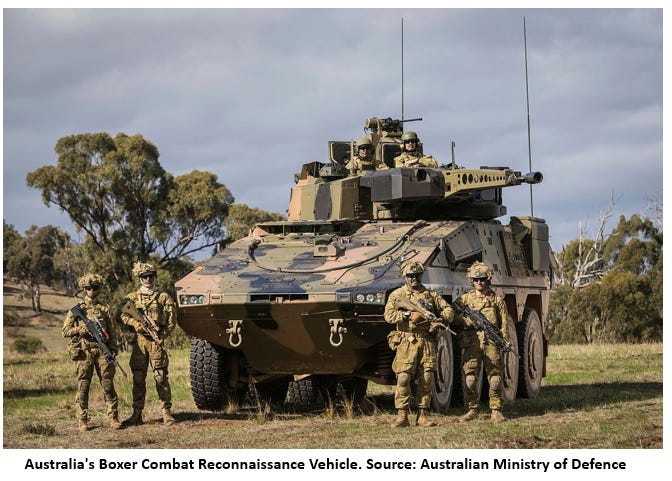
The Boxer photo really highlights the sheer size of these vehicles. The soldiers standing beside it are not small, yet they are dwarfed by the platform. It is an enormous vehicle - exceptionally well protected - but its utility and suitability for different operational environments warrant closer examination. I worked on ASLAV which I thought was very large; the Boxer is significantly bigger again.
Another great article and relevant for today.