
Initial thoughts about the US intervention in Venezuela

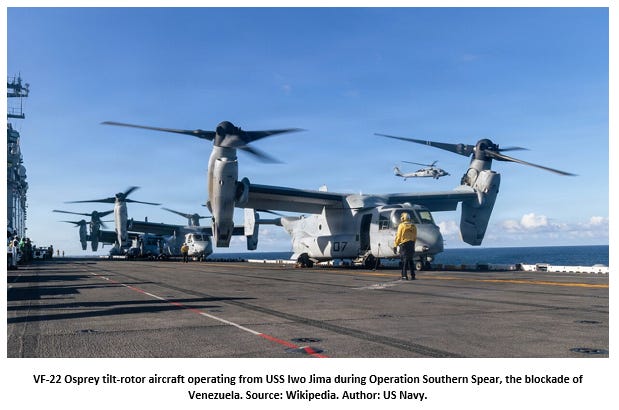
The New Year started with a large US raid to capture Venezuelan President Nicolás Maduro. The US justifies this military intervention based on allegations that Maduro supports cartels trafficking illegal drugs into America. The raid was swift and successful demonstrating that the US is very good at tactics. But does the White House have a wider strategic plan?
Background
Since January 2025, the US has increased pressure on the Maduro regime. President Trump has a history of tension with Venezuela and in March 2025, Al Jazeera noted that In his previous term he “…implemented a “maximum pressure” campaign against the South American country, imposing heavy sanctions on its government.”[i]
In early 2025, the Trump White House pressured Maduro to accept more people deported from the US. Later, the White House stopped US oil companies working in Venezuela and threatened countries buying oil from it with sanctions. Pressure on Maduro’s regime continued to increase throughout 2025, starting with a US blockade policing Venezuela’s access to the Caribbean.
By August 2025, the US had started a military build-up in the Caribbean that was followed by lethal attacks on small boats alleged to be transporting drugs into America. By October 2025, Reuters reported that there had been 14 air strikes, killing 61 people.[ii] Later in November 2025, Reuters reported on the US military build up in the Caribbean including the re-activation of Roosevelt Roads military base in Puerto Ricos.[iii]
Additionally, Reuters described a range of other US activity including flights by B-52 and B-1 bombers over the Caribbean. Intelligence gathering using P-8 Poseidon aircraft, dozens of logistics flights and the movement of key amphibious warfare ships into the area. The situation continued to escalate into December when the US seized two oil tankers leaving Venezuela.
What we know about the US raid on 3 January 2025
On 3 January, the US executed a fast well-planned raid, codenamed Operation Absolute Resolve, and captured Maduro. The operation involved a series of strikes across Venezuela’s capital, Caracas and in surrounding areas. The fact that Maduro was captured alive indicates use of a highly trained special forces team. Probably, Delta Force soldier inserted by helicopter from a US amphibious warfare ship like USS Iwo Jima.
The speed and success of the operation also indicate the US has invested heavily in infiltrating Maduro’s inner circle and was also likely to be using drones, satellite and electronic intelligence to track his location. However, nothing beats ‘human intelligence’ (HUMINT) or a well-placed ‘source’ able to confirm a target’s location.
Currently, not much is known about the attack plan but the BBC reported US strikes on the following sites:
Generalissimo Francisco de Miranda Air Base. A small airfield located within Caracas.
Port La Guaira. Caracas’s port on the Caribbean Sea.
Higuerote Airport. A larger airport approx. 150km east of Caracas.
Fuerte Tiuna. A Venezuelan Army base in the capital.
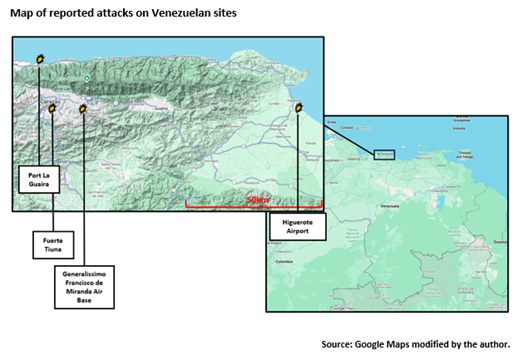
At this stage, few details are available but it seems likely the strikes against Higuerote and Generalissimo Francisco de Miranda were designed to knock out Venezuelan air defences. Venezuela has a strong air defence net work that includes modern Russian weapons like S-300VN long-range missiles, Buk-M2 medium-range missiles and Pantsir-S1 combined gun and medium-range missile systems. [iv] Air fields provide large, secure, open spaces that make them good places to deploy air defence. The attacks on the La Guaira may be similar because the Venuzaelan Navy has a small frigate with air defence missiles, or there may be land-based air defence missiles stationed there. The attack on Fuerte Tiuna army base was probably to stop soldiers there from intervening in the operation.
Substacker, Wes O’Donnell, pointed out that a US Airborne Early Warning and Command (AWAC) plane was operating near Venezuela on 1 January.[v] The AWACs plane is likely to have collected electronic intelligence about local radar frequencies, and this information would have been used by the attacking forces.
The attack’s first stage probably involved suppression or destruction of these defences and was likely to be led by carrier-based F-18 Growler electronic warfare aircraft. The Growler’s role is to jam or trick Venezuelan air defence radar and radio communications. Then stealthy aircraft like carrier-based F-35s, cruise missiles or long-range drones attacked key targets opening a ‘window’ in Caracas’s air defence for the ground teams to transit Venezuelan air space and capture Maduro.
The ground operation probably involved hundreds of soldiers. A small team of elite soldiers to capture Maduro backed by a larger force of less well-trained personnel to cordon and secure the area. Built into the larger security and support operation would be securing an extraction point, and alternative landing sites in case the operation did not go to plan. US fighter and attack aircraft would have supported the ground operation by preventing the Venezuelan Air Force from intervening and being prepared to attack targets requested by the ground troops.
This operation was a large, well-planned and well-executed joint operation that involved close cooperation between all branches of the US military. It is a demonstration of capabilities unique to the US. Russia’s unsuccessful attempt to capture Ukraine’s president at the start of the 2022 invasion provides a useful contrast to this operation.
What next?
Currently information is limited, Trump has made a statement but Secretary of State Marco Rubio provided more detail in early morning interviews with the media. [vi] Rubio’s statements can be summarised as follows.
· Rubio positioned the US intervention as a legitimate act of law enforcement. He stated that the operation is “not a war against Venezuela” and reminded listeners about Maduro’s existing criminal indictments and his dubious political mandate, saying “We don’t believe that this regime in place is legitimate via an election, and that’s not just us. It’s 60-something countries around the world that have taken that view as well, including the European Union.”
Notably, Rubio used the term ‘raid’ to describe the operation rather than ‘attack,’ ‘special military operation’ or similar warlike terminology. Police conduct raids, and Rubio’s statements aim to reinforce the law enforcement motivation. Further, a raid is temporary indicating that Rubio does not envisage a long-term US presence in Venezuela.
The aim is to position the operation as legitimate for both the international community and for domestic audiences. Internationally there is concern about the US taking unilateral action for example; the Guardian reported that Spain, Brazil, Chile, Colombia, Mexico and Uruguay have issued a joint-statement that starts “We express our profound concern and rejection of the military actions carried out unilaterally on Venezuelan territory, which contravene fundamental principles of international law, particularly the prohibition of the use and threat of force, and respect for the sovereignty and territorial integrity of States, enshrined in the Charter of the United Nations.”[vii] A sentiment many smaller nations will share. Rubio is also aiming to counter legal questions within the US about the White House’s right to conduct an operation of this nature without reference to Congress.
Regardless of Trump’s statements about ‘running the country’ Rubio was keen to push responsibility for future decision-making back to Venezuela. He discussed the US judging the country by “what they do next“ and reinforced that the US still retains “multiple levers of leverage“ to protect its interests. Rubio indicating that a potentially expensive occupation of Venezuela is off the table but that economic sanctions are being considered.
Based on Rubio’s statements it appears that the White House’s aim is to achieve regime change with a ‘light touch’ rather than by invading Venezuela. Maduro’s regime is not popular or regarded as legitimate either at home or abroad. This means there are potential leadership contenders including Nobel Peace Prize winning opposition leader María Corina Machado. However, she has already said that Edmundo González, the widely recognised legitimate winner of the 2024 presidential election should lead Venezuela. Machado’s Nobel Prize is notable because it demonstrates the lack of international support for Maduro’s regime.
It appears unlikely that US forces will be committed to Venezuela beyond the special force units already operating in the country to provide intelligence and liaison with local parties. Instead, the US will continue to apply economic pressure, retaining its ‘oil quarantine’ and financially punishing Venezuelans unless a pro-American government is elected. The CIA’s HUMINT operations have probably already identified a range key players in the political and military spheres that are being groomed, and supported to ensure this outcome.
But winning the strategic battle could be harder than expected
The US achieved its tactical goal; Maduro is gone but now the US must ‘win the peace.’ Pragmatically, this means bringing local politicians, the Venezuelan military and US oil companies together to create a new, legitimate and economically sustainable regime. The key determinant of success will be creating a secure environment that encourages US oil companies to invest in rebuilding Venezuela’s oil industry.
Venezuela has the largest oil reserves in the world and although the US is currently the world’s largest oil producer, its product is mostly lighter crude harvested by ‘fracking’ in shale deposits. Venezuela’s oil is more valuable thick, heavy crude and there is an enormous amount of it. US oil companies have the financial muscle, technical knowledge and infrastructure to profitably extract this oil. However, a recent Politico article[viii] reminds us that a prerequisite for oil company investment in Venezuela is security. Essentially, Venezuela is riddled with well-organised paramilitary drug cartels and guerilla movements like the cross border Columbian guerilla group - National Liberation Army - Ejército de Liberación Nacional, so. If the nation’s military becomes ineffective or becomes part of a resistance movement safe access to the oil fields will be impossible.
However, the position of Venezuela’s military is currently uncertain with its leaders expressing their support for Vice President, Delcy Rodríguez. An indication that Maduro’s political allies still have power. It may also indicate that America has not read the local political situation accurately or conducted sufficient covert political activity to secure the support it needs for a smooth transition. And, what is the US plan if the nation does descend into chaos? A larger military intervention? Only time can tell how this situation will evolve.
Conclusion
The US intervention in Venezuela is another indicator of recent changes in US foreign policy. The BBC’s International Editor, Jermey Bowen summed up the situation in Venezuela as follows “With the seizure of Venezuelan leader Nicolás Maduro, Donald Trump has demonstrated more powerfully than ever his belief in the power of his will, backed by raw US military power.”
The raid involved the US operating unilaterally to achieve its own geopolitical goals as per its 2025 National Security Strategy with little regard for international law. It indicates that for the Trump White House diplomacy is ‘transactional,’ bi-lateral and that ‘might is right.’ Messages that are likely to empower authoritarian regimes, and will concern US allies and partners that rely on the stability provided by the current ‘rules-based order.’
In conclusion, Maduro’s removal from power was a difficult operation and its success demonstrated the US military’s skill and tactical excellence. However, the unintended strategic consequences of this type of direct and violent intervention are harder to predict.
[i] https://www.aljazeera.com/news/2025/3/24/trump-to-impose-25-percent-tariffs-on-countries-that-buy-oil-from-venezuela
[ii] https://www.reuters.com/world/us/us-military-strikes-suspected-drug-vessels-eastern-pacific-2025-10-28/
[iii] https://www.reuters.com/graphics/USA-CARIBBEAN/MILITARY-BUILDUP/egpbbnzyrpq/
[iv]. https://www.msn.com/en-us/politics/international-relations/venezuela-s-secret-air-defense-system-gifted-by-russia-exposed-ahead-of-operation-spear

[vi] https://www.state.gov/releases/office-of-the-spokesperson/2026/01/secretary-of-state-marco-rubio-with-kristen-welker-of-nbcs-meet-the-press/ https://www.state.gov/releases/office-of-the-spokesperson/2026/01/secretary-of-state-marco-rubio-with-george-stephanopoulos-of-abcs-this-week/
[vii] https://www.theguardian.com/world/live/2026/jan/04/nicolas-maduro-jailed-us-attack-venezuela-donald-trump-reaction-latest-news-updates-live
[viii] https://www.politico.com/news/2026/01/03/trump-venezuela-oil-us-companies-return-00709782
Hi Peter, Thanks for your comments and support. Happy New Year. I think we can learn a lot from study what people say and how they say it, especially people used to having the their words interpreted and re-interpreted. Appreciate your kind words.
My thanks for your balanced and measured analysis and reporting of this extraordinary event, Ben.
I hadn't appreciated this nuance (extract from your report): "Rubio used the term ‘raid’ to describe the operation rather than ‘attack,’ ‘special military operation’ or similar warlike terminology. Police conduct raids, and Rubio’s statements aim to reinforce the law enforcement motivation."
I look forward to any further sitreps you produce on this!