
A Modern Light Motorised Force
Building on his discussion on the trend towards larger wheeled armoured fighting vehicles , guest contributor and ex-armoured corps officer Graeme Doull proposes a new solution to motorising infantry.

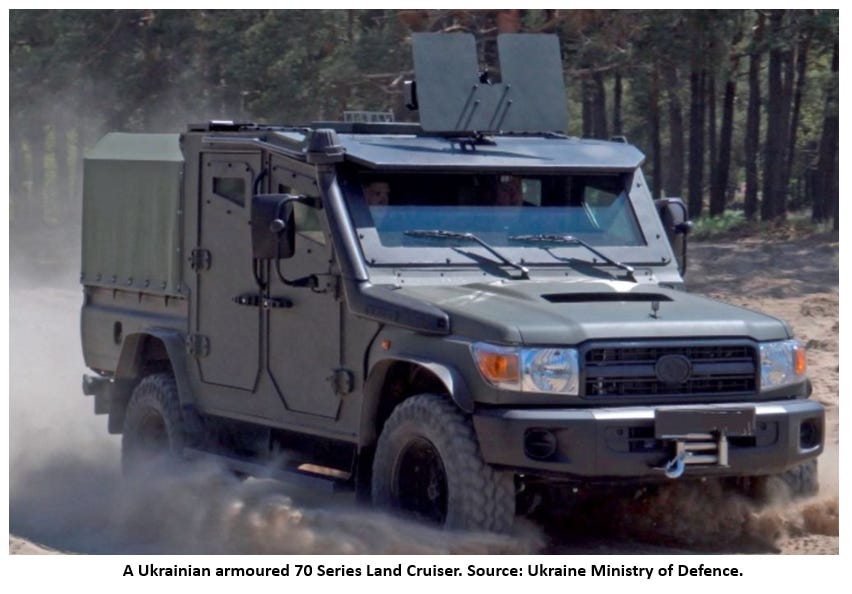
Western armies have pursued greater protection through larger, more complex armoured vehicles. The result has been solutions that are highly capable on paper but expensive to acquire, difficult to sustain, and increasingly constrained by their size and logistics demands.
Instead, imagine a platoon spread across eight armoured Toyota Land Cruisers armed with a massive volume of drones, Javelin missiles, remote weapon stations (RWS), and networked communications linked to indirect fires. Flexible, agile, lethal, and comparatively low-cost. A force designed to fight dispersed, exploit gaps, hide effectively, and operate with a lighter logistical footprint. Such a platoon could form the basis of a new generation of light motorised forces.
The current generation of heavy vehicles was shaped by the threats in their operating environment. The trend toward larger armoured vehicles was driven by the need to survive improvised explosive devices during the Global War on Terror (GWOT), where blast protection became a dominant design consideration.
In future conflicts, operating under contested airspace against a conventional adversary, different trade-offs will be required, including prioritising agility and flexibility over adding more armour. Rather than continuing to build massive, heavy targets, armies should rethink survivability - pivoting toward lighter, highly networked solutions where speed, dispersion, and tactical concealment become the new definition of force protection.
The Changing Battlespace
The emergence of ubiquitous drones, precision fires, and persistent surveillance should force a reassessment of many long-held assumptions. In this environment, mobility, dispersion, and affordability will matter more than ever.
It is time to revisit the survivability trade-off between large, expensive armoured vehicles and smaller, more agile alternatives. Survivability should be assessed holistically, not solely based on the thickness of a vehicle’s armour.
Rather than pursuing ever-heavier platforms, there is a compelling case for a new generation of light motorised forces built around lightly armoured commercially derived utility vehicles such as the Toyota Land Cruiser, equipped with modern communications, drones, and remote weapon stations.
Such a force would not replace heavy mechanised formations, nor would it seek to defeat heavy armoured units in direct combat. Instead, it would provide a highly deployable, operationally agile capability optimised for dispersed warfare.
Everything is a trade-off. Attempting to solve every battlefield problem with a single platform creates rigid and costly solutions. Heavy vehicles remain essential for many missions, but there is a growing case that future conflicts require lighter and more distributed force structures.
The Modern Battlefield Rewards Mobility
One of the clearest lessons emerging from recent conflicts is that prolonged concentration and navigation across open terrain are increasingly dangerous. Drones have made it possible to locate and track forces at unprecedented scale and at low cost. Precision-guided artillery, loitering munitions, and long-range fires can then rapidly exploit detected targets.
Survival now depends more on the ability to move smoothly through complex terrain, dispersion and concealment.
What was good ground is now bad. Previously, roads and open rolling landscapes were viewed as favourable avenues of movement. Increasingly, they have become predictable killing grounds where low cost drones hunt in numbers.
A lighter motorised force can hide more easily and and disperse across a wider area, reducing vulnerability while increasing operational reach. Rather than concentrating combat power in a handful of expensive vehicles, it makes sense to distribute capability across dozens of mobile platforms.
The Case Against Large Vehicles
When facing an adversary equipped with a near-inexhaustible supply of top-attack weapons - Javelin-equivalent missiles, loitering munitions, and low-cost attack drones - physical size rapidly becomes a liability rather than an asset.
Larger vehicles present larger targets. Advanced anti-armour weapons can threaten almost any vehicle, reducing some of the advantages traditionally associated with heavier protection. Armour alone cannot guarantee survival.
While strategic concealment may no longer be possible, tactical concealment remains vital. The ability to use terrain, vegetation, and cover to delay observation, orientation, and targeting can be the difference between survival and destruction. If a vehicle is too big to hide, and is stuck on limited routes, it becomes easier to find, easier to target, and easier to kill.
The size of vehicles can restrict mobility in many environments. Bridges, narrow roads, urban streets, vegetation, and soft terrain can all limit where larger vehicles can operate and how effectively they can manoeuvre. A smaller vehicle may be able to fit in between trees in a forestry or coconut plantation, drive cross-country across a farm, or navigate informal dirt tracks.
Big heavy vehicles need big supply chains. Heavier platforms consume more fuel and place increased stress on components - particularly moving cross country. Heavy armoured vehicles require heavy support vehicles, dedicated maintenance equipment and specialised parts - sometimes with long vulnerable international supply chains.
Why Smaller Vehicles Make Sense
Smaller platforms are generally less expensive to acquire, consume less fuel, and are simpler to maintain. A lower per-vehicle cost, both in terms of purchase and sustainment, means more resources can be made available for drones and advanced anti-armour systems.
Their lower weight improves strategic deployability by air and sea, while their compact dimensions allow access to terrain that may be difficult for larger vehicles.
Mechanical failures, battle damage, and routine maintenance have less impact when capability is distributed across a larger number of platforms rather than concentrated in a small number of expensive systems. Losing one vehicle out of a four-vehicle platoon means you can’t split into separate patrols and still have mutual support, whereas an eight-vehicle platoon retains far more tactical flexibility, even missing two or three vehicles.
Vehicle size also influences reliability. Larger and heavier vehicles place greater loads on mechanical components, increasing wear and maintenance demands over time. Engineering can mitigate many of these effects, but physics remains impossible to escape - you can’t ignore the square-cube law: bigger vehicles exert exponentially more force on every part.
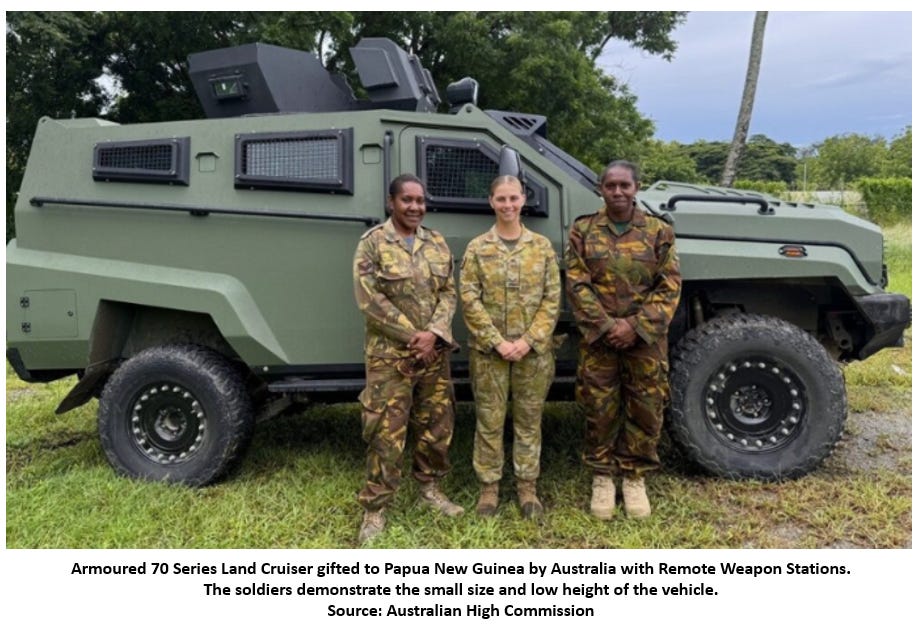
While lighter vehicles cannot match the protection levels of larger personnel carriers or infantry fighting vehicles, modern lightweight armour incorporating hardened steel, composite materials, and spall liners can still provide effective protection against small-arms fire, fragmentation, and lower-order explosive threats.
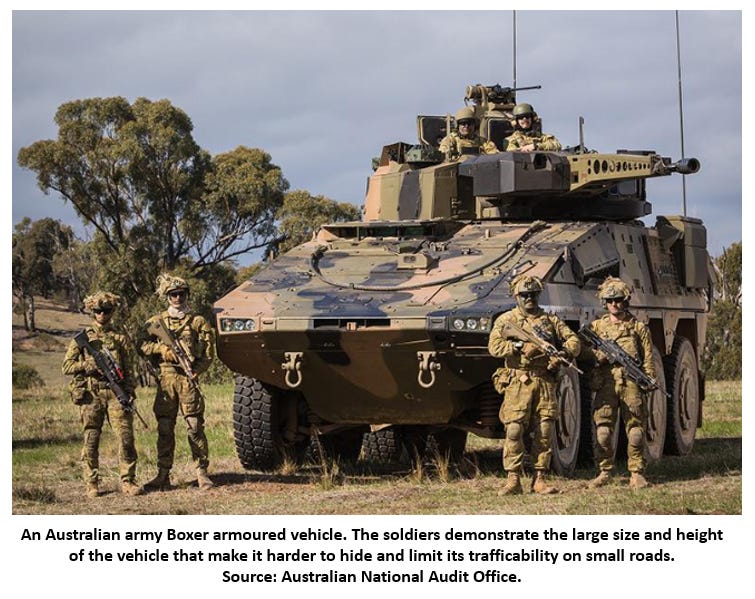
The result is a force that is harder to find, harder to target, and highly resilient to individual vehicle losses. Dispersed across the battlespace, these units can act as multiple probing fingers, constantly seeking out and exploiting gaps in the enemy’s lines, going places an armoured fist cannot reach.
Combat Power at the Platoon Level
Being mounted provides more than just mobility and better communications equipment. Motorised platoons have the capacity to organically carry capabilities that dismounted organisations typically hold centrally: advanced anti-armour weapons, sustained-fire machine gun kits (repurposing weapons from their RWS), reconnaissance and strike drones, as well as more of the basics - extra ammunition, fuel, and supplies.
This pushes combat power directly to frontline units, reducing their reliance on centralised logistics and creating a highly flexible force capable of operating across a dispersed battlespace. These small mounted units can observe, communicate, strike, and sustain themselves with a level of independence completely out of reach of a dismounted team.
Modern combat effectiveness increasingly emerges through digital networks. Sensors, drones, observers, and fire support assets combine to create a distributed kill web capable of detecting, tracking, and engaging targets rapidly across a wide area. Smaller vehicles can support all of these functions much more efficiently than either dismounted operations or heavier vehicles.
Drones and Indirect Fire as the Primary Source of Lethality
The most lethal systems on the modern battlefield are indirect fires and drones. Light motorised forces should be designed around supporting the observer-to-shooter kill chain rather than attempting to win through direct combat.
Drones provide persistent surveillance and strike on point targets. Mortars provide a rapid volume of responsive firepower for suppression of harder targets and destruction of softer ones, useful to break contact, screen and bypass.
While drone strikes and indirect fires will be available from higher echelons, motorised forces must hold significant capacity organically to ensure economy, speed of engagement, and resilience. Long-range fires and drone-launched missiles are scarce resources - mortars and shorter-range kamikaze drones should be the first options a motorised force employs.
Forces on the ground need to support the launching, maintaining and recovering drones - all networked back to higher headquarters. The armoured Land Cruisers should be heavily loaded with drones and have tools and spares for first line repairs.
To maximise the utility of a light motorised force an upweighted mortar capacity should be considered - more than the traditional single mortar platoon per battalion.
Semi-automated mortars - such as the Sling or Scorpion - reduce personnel requirements, allowing for an additional platoon without significantly increasing the battalion’s headcount. Having two mortar platoons per battalion compensates for the limited range of these systems and enables dispersed operations.
This style of automation also allows for quicker set-up and redeployment, all while operating from the same common light vehicle platform. No mortar crew wants to be caught by a drone while manually digging out a base plate, and a more capable fully automated system would need a different heavier vehicle that would add to the force’s logistics complexity.
The Remote Weapon Station Revolution
For motorised forces, one of the most significant technological developments of the last two decades has been the maturation of remote weapon stations (RWS). An RWS is a smart trade-off - less capable than a manned turret, but a significantly more capable system than a manual, pintle-mounted weapon.
These systems allow crews to operate weapons from within the vehicle and benefit from day and thermal optics, laser rangefinders, stabilisation systems, and increasingly sophisticated sensor suites. Capabilities once associated with heavier combat vehicles are now available on relatively light platforms.
The combination of stabilised sights and modern sensors also provides a substantial increase in battlefield awareness, often delivering greater operational benefit than the weapon itself. Spotting an enemy via an RWS might trigger a call for fire, or prompt a crew to dismount and deploy a Javelin from a concealed location, while the vehicle remains covered in a defilade position.
Compared with traditional light weapon mounts, RWS-equipped vehicles can engage targets more accurately, at greater distances, and with less risk to their crews. They also provide an important gateway into digital battlefield networks, enabling sensor sharing, target handoff, and improved situational awareness across the force.
RWS Role in Counter Low Cost Drone
A light motorised force must possess the capability to fight the low-cost counter-drone battle. Without it, they are incredibly vulnerable and functionally obsolete.
Advances in computer vision, machine learning, and sensor integration are rapidly improving the ability of weapon stations to detect, classify, track, and engage targets. This allows an RWS to pull dual duty as both a direct-fire weapon and an organic counter-drone system.
While likely effective against low-cost tactical drones, especially where vehicles mutually support each other, defeating strategic, high-altitude drones will still require sophisticated air-defence assets - likely from outside the motorised structure.
Logistics: The Legs of the Beast
Light motorised forces need significantly less logistics support than mechanised formations.
Military organisations often describe logistics as the tail. The metaphor is misleading. Logistics is better understood as the legs of the beast. The jaws of a legless tiger remain dangerous, but they can be easily avoided. Without logistics, combat formations cannot manoeuvre, sustain themselves, or exploit success.
Heavy forces need elephant legs - big, slow, and difficult to hide, leaving a well-trampled logistics path that is easy to interdict. The supply lines of a lighter force are leaner - leaving a smaller footprint that is naturally easier to conceal and more resilient to disruption.
There is a reason Toyota utility vehicles have become ubiquitous across many conflicts. They benefit from global supply chains, readily available spare parts, widespread maintenance expertise, and decades of operational experience in some of the world’s harshest environments. During prolonged operations, simplicity, reliability, and ease of repair can become as important as armour protection.
A Force Designed for Modern Warfare
Survivability no longer comes solely from armour thickness. It also comes from mobility, dispersion, concealment and affordability.
The US is trialing a Mobile Brigade Combat Team structure where squads operate from unarmed and unarmoured nine-person off-road buggies, providing them with mobility and the capacity to carry more weapon systems. While these buggies realise the benefits of being lighter and more nimble, abandoning all armour and lacking an RWS represents an over-correction. A mounted weapon system is critical for tactical overwatch - allowing mutual support with direct fire and counter-drone. Concentrating a nine-man squad on a single unarmoured vehicle creates a highly attractive, vulnerable target.
You can still be light and have some degree of protection and firepower. Protection is not a binary choice. Combat operations in Ukraine have consistently shown that legacy light armour - M113s, MT-LBs, and FV103 Spartans - provide critical survivability options. Even though these older platforms cannot defeat a modern anti-tank weapon, their modest armour routinely saves lives by protecting soldiers from artillery fragments, small-arms fire and less effective drones.
A light motorised force built around armoured commercial vehicles equipped with remote weapon stations offers a compelling combination of light protection, mobility, the capacity to carry and employ a wider array of tactical tools and effects, operational reach, and tactical flexibility.
For many nations, the most useful future force may not be a heavier vehicle, but a smarter one.
Thanks for reading our work. If you like this content and want to support it you can ‘Buy me a Coffee’ here - buymeacoffee.com/benmorgan
Graeme is a retired armoured corps officer and veteran. After leaving the military he has had a very successful career in civilian logistics.
Good work Ben and Graeme. A very well thought out piece indeed 👍. Good and valid points all round.
A fascinating post thanks Ben and Graham. I quote:
"Larger vehicles present larger targets. Advanced anti-armour weapons can threaten almost any vehicle, reducing some of the advantages traditionally associated with heavier protection. Armour alone cannot guarantee survival."
Might this statement forecast the end of Aircraft Carriers too? Highly vulnerable to missile and submarines etc.